We Use Food as a Tool to Strengthen Communities
Through job training, meal distribution, and local farm partnerships, we're building long-term solutions to the interconnected problems of poverty, hunger, and homelessness.
Sign-up for Our Email Newsletter
Latest Equipment Donations Will Improve Meal Production

At DC Central Kitchen, we believe waste is wrong, whether that’s waste of nutritious food, productive minds, or even useful kitchen equipment. So we’re always taking advantage of the opportunities out there to make our operations run more efficiently and effectively.
We wouldn’t have these opportunities if it weren’t for our partners, who look to us to be creative and find ways to utilize what could have been thrown away.
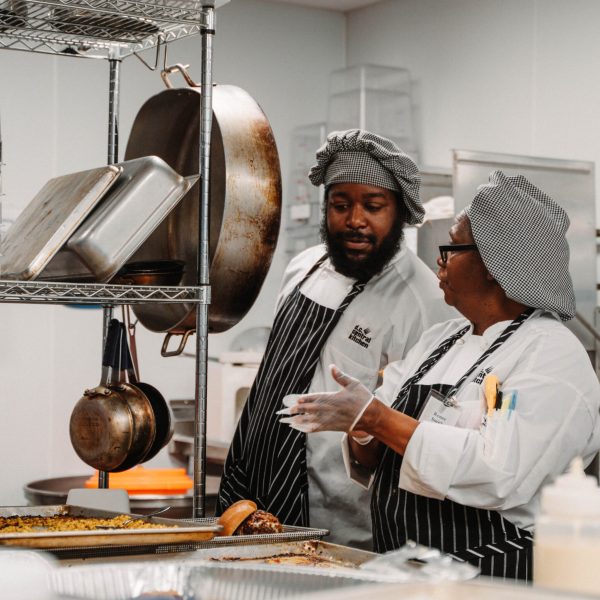
As a result of their kitchen upgrade, we are delighted this week to receive a large donation of equipment from our friends at the IMF and Sodexo including:
- 2 double stack convection ovens
- 1 Alto Sham Combi Oven (this is a really important, expensive piece enabling us to improve the quality and healthiness of our meals)
- 1 flat top griddle
In addition, we received a brand new blast chiller from our friends at CoBank. This is an essential item that will improve how we package and deliver meals.
The value of these donations will save DC Central Kitchen tens of thousands of dollars in equipment costs and productivity.
How Our Meals Have Changed
We’ve learned a lot over the years about how to get the best bang for our buck. Here are some ways we’ve improved our meals over time.
New Cooking Methods
Roasting vegetables is out, which shrinks and adds fat to our offerings. Now we’re steaming our veggies, retaining much more of their nutritional value and size.
Using Our Equipment More Effectively
We used to rely on mixing all of our ingredients in one 65 gallon kettle. That often limited us to serving soups and stews. Now we’re preparing our ingredients separately, blanching and steaming our veggies, and reserving the kettles for mass quantities of starches. This makes a more appetizing and more dignified meal for our clients.
More Balanced Portions
We’ve been adding more seasonal vegetables to our meals and creating a healthier, more balanced plate for our clients.
Integration of Menus
We’re taking what we’ve learned from making healthy, scratch-cooked school meals and applying this insight across all of our meal production. By improving our bulk ordering across all of our menus, we’re reducing costs and increasing our efficiency.
More Raw Ingredients
Over the years, we’ve moved from using mostly prepared food in our meals to more raw ingredients, which ensures we’re producing the freshest and healthiest meals for our clients.
Fresher Veggies
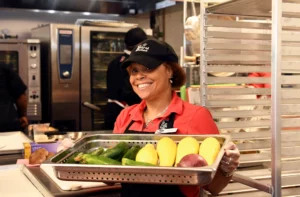
We’re getting more of our seasonal vegetables from local farms and the veggies we’re using in our meals are fresher and tastier than ever!
Better Packaging
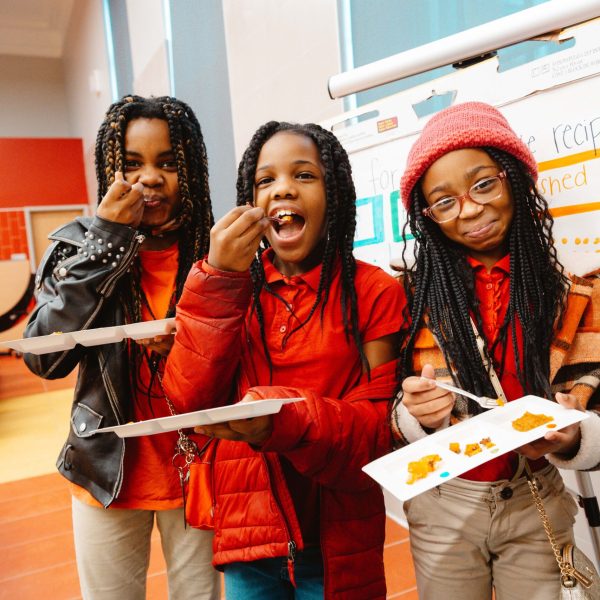
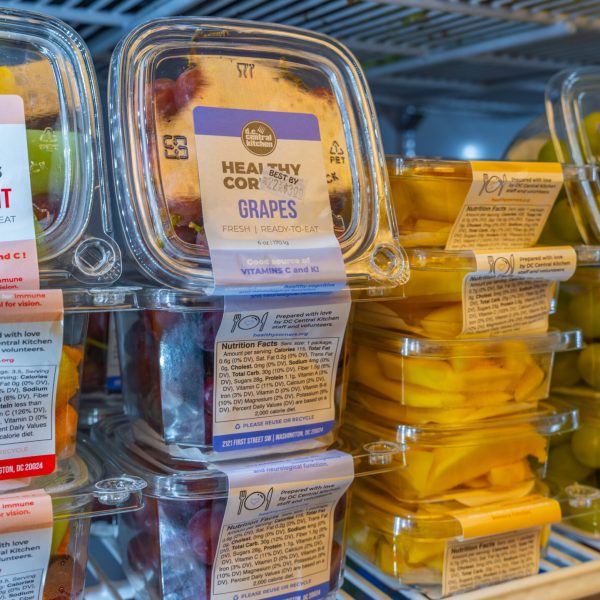
With our new vacuum sealer, we can provide professionally packaged fresh snacks packed with fresh veggies to after-school programs and corner store partners.
4 Reasons We’re Not A Soup Kitchen

DC Central Kitchen is about using food as a tool for empowerment. Here are men and women graduating from our 14 week Culinary Job Training Program.
The most common misconception about DC Central Kitchen is that we’re a soup kitchen. Here are 4 ways we are very different.
DC Central Kitchen doesn’t serve meals. Unlike a soup kitchen, no one lines up at our door to receive a meal. Using recycled food from the community and an army of volunteers, our main kitchen in the basement of the largest shelter in America produces 5,000 meals every day that are distributed to nearly 100 partner agencies around the city. The meals we produce help defray food costs of the agencies we serve, allowing them to focus more of their limited resources on their unique programming.
DC Central Kitchen is not a feeding organization. Simply feeding more people is not our goal. Food is a tool, a gateway, to make people’s lives better. With every meal we distribute comes a message of empowerment. Through our 14 week Culinary Job Training Program, we’re shortening the line of hungry people and breaking the cycle of dependency by providing real opportunities for people to make their lives better through hard work.
Our volunteers work alongside the people they are helping. This is different than a soup kitchen, where volunteers are working behind a sneeze guard barrier. At DC Central Kitchen, our volunteers chop and dice alongside students and graduates from our 14 week Culinary Job Training Program, which includes men and women just out of prison, individuals who were formally homeless, and people that once suffered from addictions. It’s not just about chopping and dicing. We’re challenging stereotypes about “the poor” and “the hungry” in the process.
We’ve pioneered social enterprise. We don’t get by pleading for pennies. Through our healthy meals for DC Public Schools, in-house catering business, and partnership with corner stores to provide fresh produce, we’re generating 60% of our own revenue, becoming more sustainable, and providing innovative solutions to combat hunger and promote health in the community. All of our social enterprise projects employ our culinary graduates at living wages and provide more opportunities for those who were previously dependent on society to give back.
Restaurants Give Back to Offer Hope, Advice to Chronically Unemployed

Chef Vinod from Indique, a restaurant participating in Sound Bites, sharing culinary wisdom with students on Heritage Day.
Adults who were unemployed, in prison, or homeless just a few months ago are cooking their way to success through DC Central Kitchen’s Culinary Job Training Program. Their first challenge? Whipping up empanadas that will be judged by professionals in the restaurant industry.
The Culinary Job Training Program is just one of the DC Central Kitchen programs that benefits each year from Sound Bites, an outdoor food and musical festival on May 19 at the 9:30 Club. The event will feature dishes from such notable restaurants as El Centro, Bar Pilar, Pearl Dive Oyster Palace, The Hamilton, and many more.
Beyond the event, restaurants featured at Sound Bites are getting involved in other ways. Chef Anthony Lombardo from 1789 and Lori Scott, Sales & Marketing Manager from Gordon Biersch, will meet students and provide career advice during the students’ cook off on May 8. Lombardo is an active supporter of the Culinary Job Training Program and Gordon Biersch recently raised $7,800 for DC Central Kitchen from their Navy Yard location opening.
To prepare for the cook off, students, who work in teams, are expected to research empanada recipes and bring them to team members for collaboration. Teams have two days to choose, practice, and tweak the dish for the competition.
The cook-off occurs during week six of the 14-week program, which trains students for careers in the food industry, including all facets of work in a professional kitchen. Additionally, students attend self-empowerment sessions and graduates are assisted in an intense job search to obtain full-time employment at local restaurants, hotels, caterers, and other hospitality businesses.
“We couldn’t do our work without our partners in the restaurant industry,” said Paul Day, Communications Manager for DC Central Kitchen. On April 24, chefs from four participating Sound Bites restaurants visited DC Central Kitchen on Heritage Day, a hands-on cooking demonstration that provides culinary skills and career guidance to students in the program.
“This program provides a unique opportunity to encourage an open dialogue about personal challenges and then we help the students develop strategies for dealing with them,” said Marianne Ali, Director of Culinary Training. “We use food preparation to prepare students for future careers, but also to teach life skills.”
For students like Shania, the program provides a unique opportunity for growth. “It has been challenging in every way,” she said. “It’s helping me with the constant battle to break out of my old patterns.”
For others, the program teaches discipline. “I’ve learned to accomplish a lot of things, like being more responsible, and to not let my attitude disrupt my future,” said Lawrence. “I am learning how to ask for help.”
Our Elders Deserve More
This post was republished in The Huffington Post.
Earlier this week, The Huffington Post’s Arthur Delany crafted a wrenching narrative of sequestration striking senior citizens through its painful cuts to the Meals on Wheels system. That up to four million meals have been taken from our elders by way of the avoidable, self-inflicted crisis of the sequester is appalling–but the suffering caused by these cuts offers only a small sampling of what will come as America’s aging crisis approaches. By 2030, this country’s population of older adults will have doubled in size since 2000, to 72.1 million people. Although allowing these people to age with dignity is hardly an example of ‘wasteful’ spending, the onset of American austerity should inspire us all to seek new, cost-effective solutions.
Recently, a Brown University study found that feeding senior citizens in their homes reduces the need for nursing homes. More meals, less long-term care. That’s a good start. But at DC Central Kitchen, we know that ‘more meals’ is never a solution by itself. All too often, organizations devoting to fighting hunger focus on filling the stomach, to the exclusion of nourishing the whole person. Stomachs can only be full for so long before they need another meal. Then those clients are back again, day after day, rendered dependent until the funding dries up. On an infinite timeline, this is not a pretty picture.
There are better ways to nourish and empower our elders. At DC Central Kitchen, we’re testing a few of them, with powerful results.
One way involves rethinking what we actually feed them. Dusty smatterings of canned food belong in our basements, not the bodies of older adults. We need to rebuild our food systems around the sorts of fresh, wholesome items that can be efficiently aggregated, prepared, and shared with senior citizens. It’s not news that America wastes incredible quantities of food. Wasting 52% of our fresh fruits and vegetables, however, is not just unseemly–it’s incredibly stupid. These are our best weapons in promoting long-term senior health, but most every crooked carrot, off-color pepper, or oversized yam is left to rot in the field. At DC Central Kitchen, we recover more than 300,000 pounds of unwanted produce each year and pay farmers fair prices for items they could not otherwise sell. Our model generates new income for them and brings bumper crops of dimpled and off-color fruits and vegetables into our urban kitchen. This fresh produce infuses our nutritious, economical meals and represents an investment in the long-term health of our city’s seniors. It works in Washington, DC. It can work just about anywhere.
Another way involves getting seniors out of their homes to lead lives with meaning. “Retired” should not be synonymous with “idle.” People with decades of professional and personal experience have much to offer, especially when sharing their knowledge with young people eager to solve long-standing problems. DCCK’s national arm, The Campus Kitchens Project, is a student-led initiative that empowers young people to start their own community kitchens in college dining halls and high school cafeterias, turning leftovers into real meals for those in need. CKP is a pioneer in the field of intergenerational service, expressly recruiting senior citizens to support these efforts. Seniors then impart what they know to a new generation of civic leaders while re-connecting with their community. If we are going to make a big deal out of feeding senior citizens–and we should–let us make sure we are fueling them for a greater purpose.
Developing the food systems and community service infrastructure necessary to carry out these changes will be costly in the short term. We should not see these activities as expenses, but as investments. As it stands today, retirement will look very different for people who are under 30, like me. It may disappear entirely. If we want it to be around for us, we need to change what it looks like today. By all means, let us defend Meals on Wheels to fight short-term hunger and reduce long-term care costs. And let us drive down our health costs further with preventative, inclusive measures that allow senior citizens to be healthier, more active, and more engaged as they age. The sequester is not the real villain here. It’s a popular definition of ‘wasteful’ that seemingly applies only to money spent on the most vulnerable among us–not the fresh produce and productive minds our country casts aside each day.